Not every productivity improvement requires a new chair or a standing desk. Some of the most impactful changes come from $20 purchases and five-minute rearrangements. Here are the 10 that made the biggest difference in my own setup — ranked by impact-to-effort ratio.
Hack 1: The Desk Reset Rule
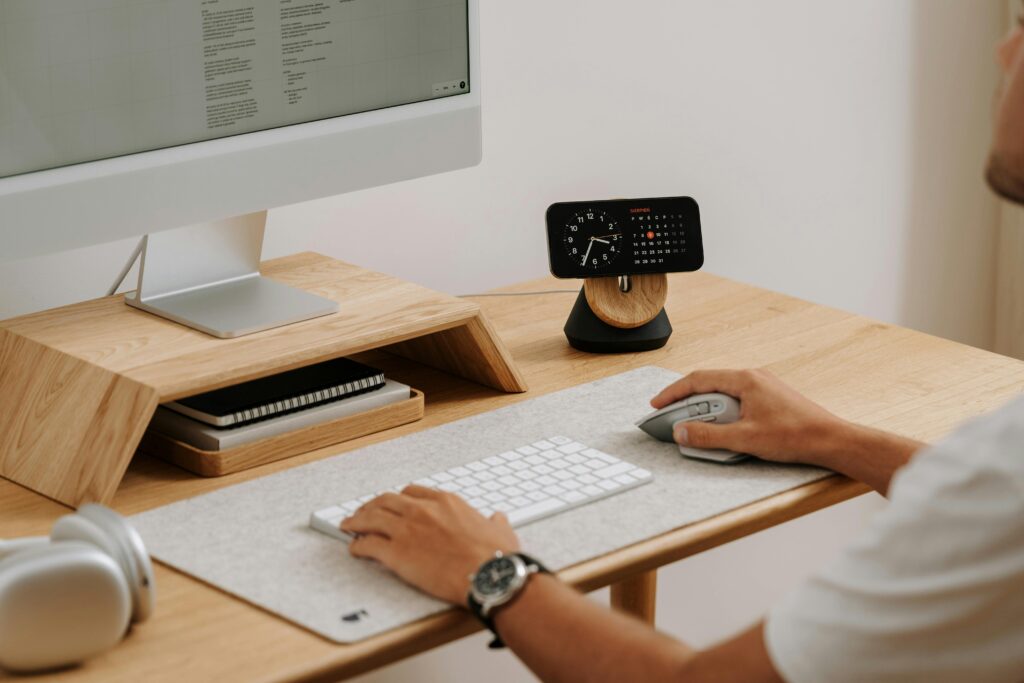
Every item on your desk should have a home — a specific place it lives when not in active use. At the end of each day, everything goes back to its home.
This isn’t about being tidy for tidiness’ sake. Research on “environmental cues” shows that visual order in your workspace activates neural patterns associated with control and focus. A cluttered desk isn’t just annoying to look at; it’s actively competing for your attention at a low level throughout the day.
The reset takes 3 minutes. The return is worth 20–30 minutes of better focus.
Hack 2: Kill Your Cable Chaos
Velcro cable ties: $8. Under-desk cable tray: $25. Cable box to hide your power strip: $20.
Total investment: $53. Total time: 90 minutes on a Saturday.
The return: a desk that doesn’t look like an IT closet, and — more importantly — a subtle but real reduction in the background cognitive load of looking at chaos for 8 hours a day.
Hack 3: Dedicated Task Lighting
The overhead light in your room was not designed for desk work. It casts shadows over your work surface and contributes to eye fatigue after 4–5 hours.
A monitor light bar ($35–$60) clips to the top of your monitor and illuminates your desk surface without creating screen glare. It changes the quality of your visual environment measurably.
If you prefer a desk lamp: look for a minimum CRI (Color Rendering Index) of 90 and a color temperature around 4000K — neutral white, not harsh blue-white.
Hack 4: Second Monitor or Screen Extension
A University of Utah study found that adding a second monitor increases productivity by 20–30% for typical knowledge work. That’s not a marginal gain.
The reason is task-switching cost — every time you alt-tab between windows, your brain takes 15–30 seconds to reorient. With two screens, your reference material stays on one screen while you work on another, eliminating most of that switching cost.
Hack 5: Standing Mat (Even Without a Standing Desk)
If you already have a standing desk, a standing mat is not optional — it’s essential. Standing on a hard floor for more than 30 minutes causes fatigue that a mat reduces by 40–60% according to occupational health research.
But standing mats also have value even if you stand for just short periods — stepping up to take a call, reviewing documents, or thinking through a problem. The mat signals physically that you’re in a “stand-to-think” mode, which many people find activating.
Hack 6: Headphone Organization
Every time you put your headphones directly on your desk, they take up space, look messy, and have a small chance of being knocked off. A headphone stand ($15–$40) solves this permanently.
Many current stands include a wireless charging pad. Your headphones live on the stand between uses, charging continuously. You never have them die in the middle of a meeting again.
Hack 7: One Real Plant
This sounds soft. The research is not.
NASA’s Clean Air Study identified specific indoor plants that measurably reduce volatile organic compounds in indoor environments. More practically, a 2014 study in the Journal of Environmental Psychology found that workers in environments with plants reported higher satisfaction, lower stress, and better self-reported productivity.
You don’t need a greenhouse. One medium-sized plant on or near your desk is enough. Snake plants, pothos, and ZZ plants are the indestructible choices for people who aren’t gardeners.
Hack 8: The Shutdown Ritual
Remote work blurs the boundary between work and home in ways that are genuinely harmful to long-term wellbeing and performance. Without a physical commute to mark the end of the workday, the brain doesn’t get a clear signal that work is over.
A shutdown ritual is a deliberate, consistent sequence of actions that marks the end of the workday. Mine: close all browser tabs, write tomorrow’s three priorities in my notebook, lock my computer, cover my keyboard. Takes 5 minutes.
Research on “cognitive closure” shows that completing a task — even a ritualistic one — reduces the rumination that keeps work in your head during personal time.
Hack 9: Keyboard Shortcuts for Everything You Do Repetitively
Every application you use has keyboard shortcuts for its most common functions. Most people use maybe 5% of them. Learning the shortcuts for the 10 things you do most frequently saves between 15–45 minutes per day depending on your work type.
Start with one application. Spend 20 minutes learning its top 10 shortcuts. Use them for a week. Then move to the next application.
Hack 10: The Weekly Desk Reset (10 Minutes, Sunday Evening)
Once a week, spend 10 minutes returning your desk to clean-slate condition. Deal with accumulated paper, return cables to their paths, clean the monitor and desk surface.
This weekly reset takes about 10 minutes to maintain once the initial organization is in place. The payoff is starting each Monday in a clean environment — which consistently produces a different mindset than starting in last week’s mess.
Ready to upgrade your desk setup equipment? We’ve reviewed the best in every category.
Browse Our Product Reviews →