Research-based guide · Marcus Webb · WorkspaceWisePro
If you are over about 6’2″, “ergonomic” often still means a seat and backrest built for a shorter torso and shorter legs. You drop the seat to get under the desk and your knees float; you raise it for thigh support and the desk apron hits your legs; the headrest kisses mid-skull or never reaches you. This piece is research-based: it translates common anthropometric and workstation guidance (popliteal height, sitting eye/shoulder height patterns, Cornell/OSHA-style clearance checks) into measurements you can take at home. It is not a claim that we fitted every chair to every tall body in a lab.
Fit-first rule: decide with a tape measure and a clearance test, then shop features — not brand stories. When you are ready to compare shortlists, use our ergonomic office chairs pillar and the chairs under $500 guide. Those pages carry product detail; this article does not link to retailers or ASINs. For the broader tall-user product checklist, see our office chair fit guide for tall people.
Measure fit here first, then compare shortlists below. This article has no retailer / Amazon links by design.
Minimum seat height needed
Seat height should track popliteal height (floor to the crease behind the knee) so thighs are roughly parallel to the floor and feet plant flat — or on a stable footrest if the desk forces a compromise.
Home measurement
- Wear the shoes (or socks) you actually work in.
- Sit on a firm surface with feet flat; measure from the floor to the popliteal crease (behind the knee), not the kneecap.
- That distance ≈ the seat height you need at the compressed cushion (foam sinks — add a little if the pan is soft).
Why tall users miss on “standard” chairs
Over 6’2″ the failure mode is usually the maximum, not the minimum: the seat tops out before thighs are supported.
| Popliteal height (approx.) | Seat travel demand |
|---|---|
| ~18–19″ | Many standard max heights still work |
| ~19–20″ | Prefer a published high max (often ≥20–21″ unloaded — verify compressed) |
| ~20–21″+ | Filter for tall / extended gas-lift; unmarked “one size” is often short |
Measure yourself — two people at 6’4″ can differ by an inch+ in leg length.
Desk coupling
If the desk is low, a correct tall seat may not roll under. Fix order: (1) seat height for legs, (2) desk height or keyboard tray, (3) armrest clearance. A sit-stand surface that goes higher often solves what a taller chair alone cannot.
Buy if: published seat-height max meets popliteal height after compress, or an extended cylinder.
Skip if: only the minimum is advertised, or tall-user reviews say “already at the top stop.”
Backrest and headrest height
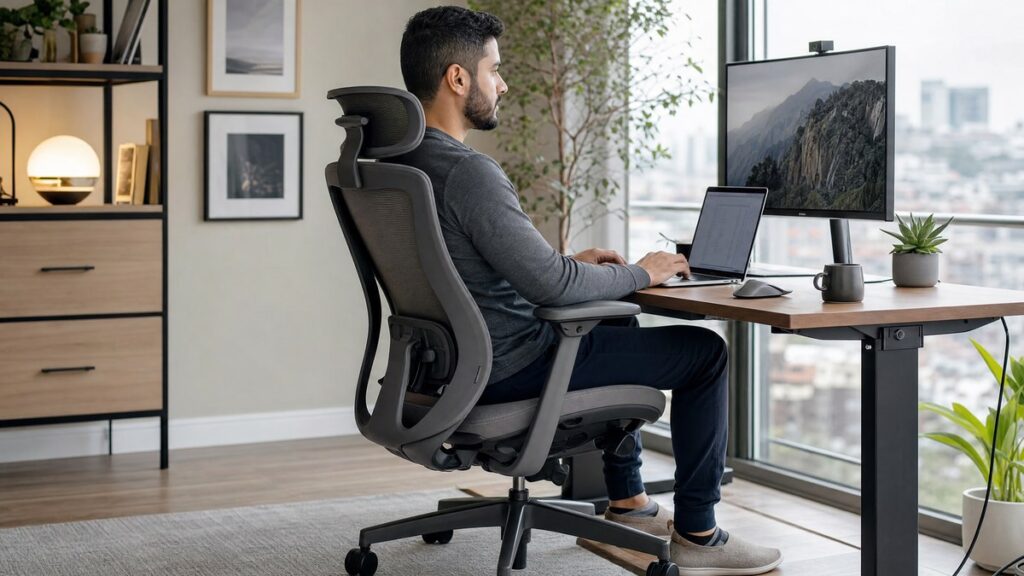
Tall torsos need the lumbar peak lower relative to the headrest than marketing photos suggest — and they need the upper back and head support to actually reach the thoracic curve and skull, not stop mid-shoulder blade.
Backrest height
- Sit fully back at correct seat height (feet supported).
- Lumbar should hit the small of the back — not mid-back because you slid down for the headrest.
- Prefer independent lumbar height (depth too when available).
- Upper back should support you upright and in mild recline without a posterior pelvic tuck.
Headrest reality check
| Headrest behavior | Tall-user verdict |
|---|---|
| Long height travel + angle | Prefer — test upright typing, not only full recline |
| Fixed executive pillow | Often hits neck/mid-skull; skip unless it luckily matches |
| No headrest, tall back | Fine for focus work; add only if you recline for calls |
| Short back + clip-on | Often lacks travel for >6’2″ — verify before relying |
Buy if: lumbar hits your curve and any headrest reaches the base of the skull without chin push.
Skip if: you must slouch or slide forward to touch the headrest — geometry miss, not “break-in.”
Tradeoff: a high back without a headrest beats a low back with a decorative pillow.
Knee and desk clearance
Over 6’2″, the collision is often knees vs desk apron and thighs vs underside, not just seat height.
Measure the conflict zone
- Floor → desk underside (lowest point: apron, drawer, metal frame).
- Floor → top of thigh when seated at your target seat height.
- Knee clearance forward: can you sit close enough that the backrest remains engaged while typing, without kneecaps hitting a modesty panel?
Clearance targets (practical)
| Check | Pass | Fail |
|---|---|---|
| Thigh vs underside | ≥1–2″ free upright | Thighs rub; you roll back and lose lumbar |
| Apron / drawer | Knees clear at full sit-in | Must perch at the front edge |
| Armrest vs desk lip | Arms drop under or pull back | Shoulders shrug or lose backrest |
| Keyboard reach | Elbows ~90° with back contact | Far sit forced by clearance |
Raise a sit-stand surface to match a taller seat when you can. Fixed low desks may need a tray or higher desk — do not “solve” tall fit by destroying lumbar contact.
Buy if: seat height and arms clear your underside while fully back.
Skip if: the apron is immovable and lower than thigh height at the correct seat — fix the desk path first.
Weight capacity vs frame stability
Marketing weight ratings (e.g., 250 / 300 / 350 lb) are not the same as feel for a tall user. A tall torso raises the center of mass; recline and side-reach amplify side-to-side racking even when you are well under the printed limit.
What to read on the spec sheet
- Rated capacity — structural ceiling, not a comfort guarantee.
- Base / casters — wider bases reduce tip when you lean.
- Recline — stronger tilt tension and an upright lock that holds.
- Frame/cylinder warranty — longer coverage helps when you live at higher seat settings.
Stability field checks
- Fully back, feet slightly lifted — feel for base rock.
- Recline halfway and type — lumbar should not swing away.
- At your max needed height — cylinders that feel fine low can chatter high.
Buy if: capacity exceeds body weight and the chair feels planted in mild recline at working height.
Skip if: bare-minimum capacity, narrow base, or upright lock will not hold a tall torso.
Tradeoff: a planted heavier frame beats a light “racing” chair with a high rating and a twitchy cylinder.
Measurement worksheet
Copy before you open any shortlist.
Body
| # | Measure | Your number |
|---|---|---|
| 1 | Height | ____ |
| 2 | Popliteal height (floor → behind knee) | ____ in |
| 3 | Buttock–popliteal length (depth check) | ____ in |
| 4 | Sitting elbow height (floor → elbow, typing posture) | ____ in |
| 5 | Preferred headrest contact (base of skull) — yes/no need | ____ |
Desk
| # | Measure | Your number |
|---|---|---|
| 6 | Floor → desk topside (work surface) | ____ in |
| 7 | Floor → desk underside (lowest apron) | ____ in |
| 8 | Sit-stand? Max standing surface height | ____ in / N/A |
Chair must-haves (feature filters — no SKUs)
| Filter | Target from your numbers |
|---|---|
| Seat height max | ≥ item 2 (after cushion compress) |
| Seat depth | ~80–95% of item 3 with ~1″+ / two fingers behind knees |
| Lumbar | Hits small of back at full sit-in |
| Headrest | Optional; only if travel reaches item 5 without chin push |
| Arms | Reach item 4 without shrugged shoulders; clear item 7 |
| Capacity / base | Above body weight with stable base at your height |
Pass / fail at the chair
- ☐ Feet supported at correct thigh angle
- ☐ Two-finger gap behind knees when fully back
- ☐ Lumbar correct without perching
- ☐ Headrest usable or consciously skipped
- ☐ Knees/thighs clear underside
- ☐ Arms support typing under/at desk lip
- ☐ Mild recline feels planted
Take the completed worksheet to the shortlists linked at the top (chairs pillar + under-$500). Match features first.
FAQ
What seat height do users over 6’2″ usually need?
Often a max around 19–21″+, but the real target is your popliteal height — not a chart. Soft cushions compress; verify at the height you actually sit.
Do tall users always need a headrest?
No. A tall backrest can be enough for upright work. Add a headrest for recline/calls only if it reaches without chin push.
Why do my knees hit the desk when seat height feels right?
The underside / apron is lower than thigh height at a correct seat. Raise a sit-stand desk, add a tray, or change desks — do not permanently drop into a hips-low perch just to clear the apron.
Is a higher weight rating enough?
Necessary but not sufficient. Also want a stable base, usable tilt tension at your height, and a cylinder that does not sink.
Buy any chair labeled “tall” or “big and tall”?
Labels are a filter, not a guarantee. Verify seat max, back/headrest travel, depth, and desk clearance. Some “tall” chairs add width/capacity without raising the seat enough.
Where next after measuring?
Bring the worksheet to the chairs pillar and under-$500 guide. This page stays fit-first — no retailer or ASIN links.
Next step
- Measure popliteal height, seat depth need, and floor → desk underside.
- Decide whether you need a headrest or only a taller back.
- Filter for seat-height max, lumbar travel, arm/desk clearance, and frame stability.
- Only then open the money-page shortlists linked above.
Research-based guide. Not hands-on lab testing of every chair or body type. Anthropometric targets and workstation clearance rules are general decision aids — verify published specs and return windows before you buy. Track B: no product affiliate links in this article.